Articles
Research and practical perspectives on strategy, leadership, governance and organisational change.
Strategic planning that delivers outcomes
20th August 2026
A practical synthesis of recent research into what makes strategic planning more likely to translate into action and outcomes.
Universal platforms might be the key to service integration
3rd September 2026
Rethinking service integration: what can neighbourhood health and local healthcare learn from Doveton?
When there's too much work, who decides what gets done?
Published in The Mandarin, 21st September 2026
In publicly funded organisations, demand for policy, advice and service delivery can quickly outstrip the resources available to deliver them. So how can managers and teams prioritise workload when demands just keep growing?
This article explores four different approaches to workload prioritisation and considers who should make the trade-offs when organisational demands exceed available capacity.
How do you make sure your strategic plan actually delivers intended outcomes?
Strategic planning is a critical part of the management of organisations funded via public money. And evidence has shown that a majority of surveyed public organisations believe strategic planning leads to improved service delivery outcomes. [1]But successful implementation of a strategic plan is not guaranteed.So, what factors will improve the likelihood that strategic planning translates to action and outcomes when it comes time to implement? A review of recent relevant literature reveals four distinct areas that improve the odds of success.
Capability - Who is doing the strategic thinking and how do they think?
The mindset and posture of those leading the strategic planning process is critical to the eventual success of the plan. [2]The team must:
Be open minded in their research of environmental and contextual factors facing the organisation
Distil crucial from irrelevant information
Analyse, evaluate and synthesise the information they find
Enjoy and encourage constructive challenge of ideas among themselves and with others
Use analytical tools and follow analytical processes [3]
This resonates with my experience. In-house teams need access to cross-organisational expertise and knowledge and the skill to navigate conversations that will support decision makers to weigh up different priorities and separate critical from nice-to-have goals and strategies.
Process - How will the strategy be developed?
Formal planning processes — involving systematic analysis of the organisation and its environment, definition of goals and formulation of plans [4] — have been found to improve implementation success, particularly for organisations facing high degrees of environmental or stakeholder uncertainty. [5]Formal processes should ensure they:
Are comprehensive in consideration of environmental and contextual factors before setting goals, strategies and actions [6]
Generate strategic options before selecting strategies [7]
Are iterative with feedback loops that refine the direction of the strategic plan [8]
Engagement - Who needs to be involved for the strategy to have traction?
Factors found to improve the potential for successfully implementation of strategic plans include:
Engaging public sector managers in the development of the strategic plan, not just its implementation [9]
Carefully considering which stakeholders to include in the development of the plan, and how to engage them [10]
Identifying how stakeholder support can help achieve overall organisational goals through the implementation of the plan [11]
Using the process of producing a strategic plan to educate and align the broader organisation behind the goals and actions in it [12]
As a practitioner, I have found deciding who to engage and on what to be a critical element of a strategic planning process. There is a risk in consulting too widely and raising expectations of the strategic plan. This is why it is critical to start with an understanding of what the strategic planning process aims to achieve.
Product - Will the plan give sufficient clarity to drive action?
There is a significant body of evidence setting out what to include in a strategic plan, which is beyond the scope of this article.When considering the factors that are likely to lead to successful implementation, it is important to ensure the strategic plan states:
What it wants to achieve,
How it wants to achieve it including through the development of formal action plans [13]
Why those things are important – what was the reasoning behind the decisions taken in the framing of the plan [14]
Beyond these areas, there are other factors that can affect whether strategic plans will translate into action including the resources allocated to the strategic planning process, the importance that senior leaders place on the plan and the planning process and the constraints that the existing policy setting, budgets and political environment might place on the organisation.
End Notes
[1] Vandersmissen & George (2024)
[2] George (2021)
[3] George (2021)
[4] George, Walker & Monster (2019)
[5] Elbanna et al. (2016)
[6] Milutinovic and Jolovic (2010), cited in Vandersmissen & George (2024)
[7] George, Walker, and Monster (2019)
[8] Bryson et al. (2022) and Poister et al. (2010), cited in Vandersmissen & George (2024)
[9] Elbanna et al. (2016)
[10] George (2021)
[11] Pfeffer and Salancik (1978), cited in Elbanna et al. (2016)
[12] Alonso (2014), cited in Vandersmissen & George (2024)
13] Elbanna et al. (2016); Milutinovic and Jolovic (2010), cited in Vandersmissen & George (2024)
[14] George (2021), drawing on Olson, Parayitam & Bao (2007)
References
Elbanna, S., Andrews, R., & Pollanen, R. (2016). Strategic planning and implementation success in public service organizations: Evidence from Canada. Public Management Review, 18(7), 1017–1042. https://doi.org/10.1080/14719037.2015.1051576George, B. (2021). Successful strategic plan implementation in public organizations: Connecting people, process, and plan (3Ps). Public Administration Review, 81(4), 793–798. https://doi.org/10.1111/puar.13187George, B., Walker, R. M., & Monster, J. (2019). Does strategic planning improve organizational performance? A meta-analysis. Public Administration Review, 79(6), 810–819. https://doi.org/10.1111/puar.13104Vandersmissen, L., & George, B. (2024). Strategic planning in public organizations: Reviewing 35 years of research. International Public Management Journal, 27(4), 633–658. https://doi.org/10.1080/10967494.2023.2271901
Rethinking service integration: what can neighbourhood health and local healthcare learn from Doveton?
The Kings Fund series on neighbourhood health has really got me thinking.It adds a really useful contribution on the conditions for success in neighbourhood health, based on international examples, including local relationships, community knowledge, funding certainty, workforce structures and measurement approaches that take into account the time it takes for transformation to embed.So I began reflecting on some of the analogous place-based examples I’ve encountered across my career, particularly in health, early childhood and community services.The one that has really stuck with me has been the Doveton Our Place model.It can’t really be labelled a health model. It is so much more than that providing services across health, early childhood, education and community participation.Community health has long demonstrated the value of bringing multiple services together in a local setting. What struck me about Doveton, though, was the choice of platform: rather than making the health service the place people come to access multiple supports, it uses a universal institution — the school — as the platform around which health, early childhood, education and community services can integrate.This feels quite different to how we often talk about integration across and within systems, where people are ‘referred’ from one service to the next and sometimes back again.People become the cogs moving through the service providers, rather than the services being the cogs moving around the people.
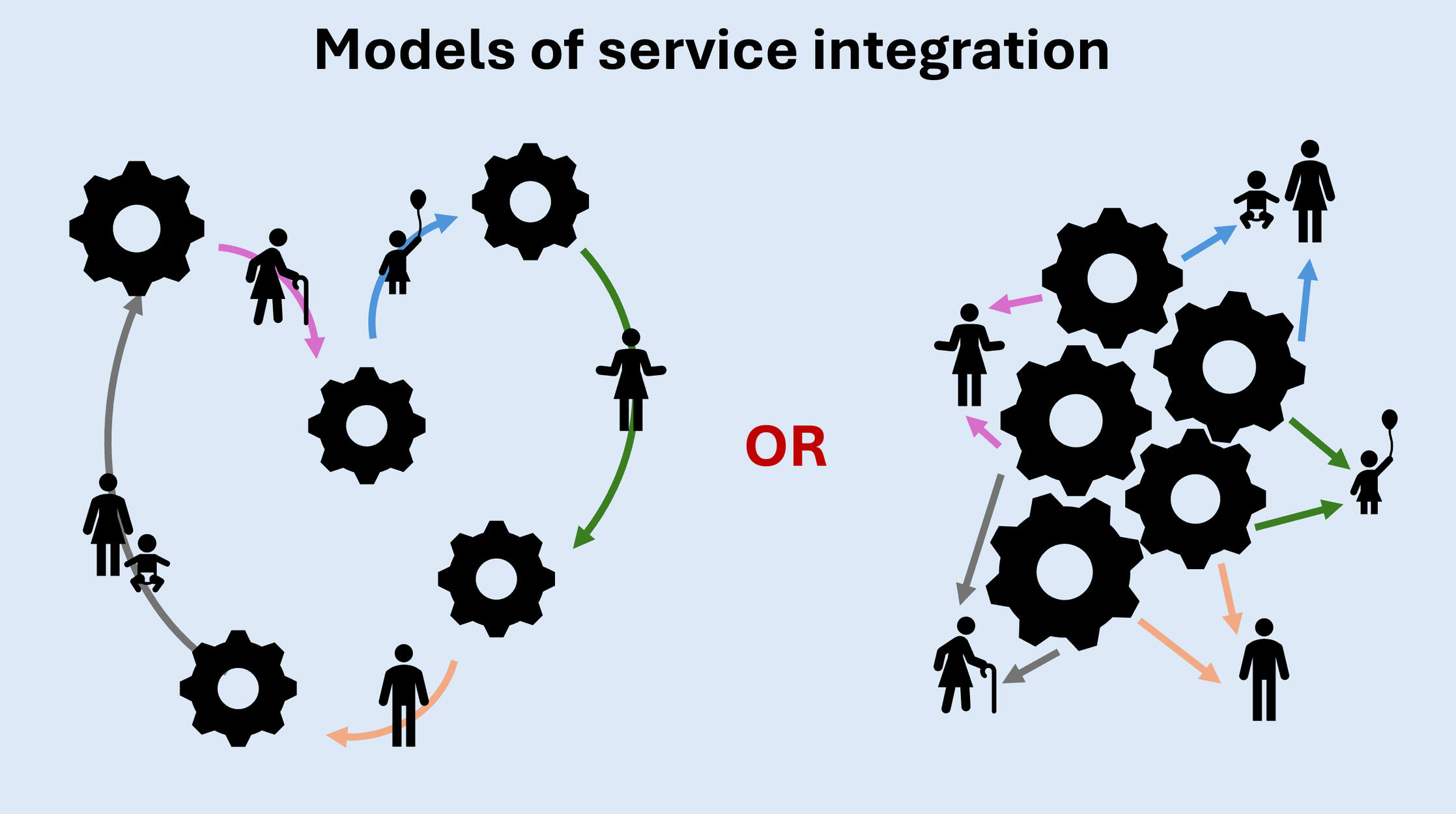
No doubt, having the school as the platform helps. People already gather there, without stigma, as part of their daily lives. But not all people in a community gather around schools.So perhaps this is the harder question for neighbourhood health to grapple with.When so many of our publicly funded service systems are (rightly) focussed on those with greatest need, how do we create service delivery systems that are accessible to all while still directing scarce resources to those who need them most?Perhaps the answer lies in finding the right platform around which these services can integrate.
Related reading
Why has the vision of neighbourhood health been so hard to realise?
https://www.kingsfund.org.uk/insight-and-analysis/blogs/hard-to-realise-neighbourhood-healthNeighbourhood health needs the perfect conditions to thrive, not a perfect model
https://www.kingsfund.org.uk/insight-and-analysis/blogs/neighbourhood-health-needs-perfect-conditions-not-perfect-modelNeighbourhood health: an international exploration
https://www.kingsfund.org.uk/insight-and-analysis/long-reads/neighbourhood-health-international-explorationOur Place - Doveton
https://ourplace.org.au/our-sites/doveton/
Contact
For advisory, coaching or facilitation enquiries, please email [email protected] or connect with me on LinkedIn.
I am based in Melbourne and work with clients across government, health, human services, education, not-for-profit and purpose-led organisations.